35% cost-per-deal reduction · 417 Automotive 40% conversion improvement · Zymbyo 60% deployment time reduction · AI workflows 24% free-to-paid conversion · Zymbyo PLG $2M+ annual media budget managed 21 live AI tools deployed 1 production AI agent live · 5 architected Confidence gate architecture · human-in-the-loop by design Model routing · Haiku → Sonnet by task complexity 10+ years in marketing · Burlington, Ontario 35% cost-per-deal reduction · 417 Automotive 40% conversion improvement · Zymbyo 60% deployment time reduction · AI workflows 24% free-to-paid conversion · Zymbyo PLG $2M+ annual media budget managed 21 live AI tools deployed 1 production AI agent live · 5 architected Confidence gate architecture · human-in-the-loop by design Model routing · Haiku → Sonnet by task complexity 10+ years in marketing · Burlington, Ontario

Arupjyoti Nath

Marketing leader who builds the AI systems inside it. Ten years of campaigns, budgets, and teams — the last few years using AI to make all of it work better.

Started in engineering. Ended up in marketing. Now building AI into the gap between the two.

24%
free-to-paid conversion · Zymbyo PLG
35%
cost-per-deal reduction · 417 Automotive
$2M+
annual media budget managed
10+
years B2B & B2C marketing

Based in Burlington, Ontario. Open to senior marketing, AI operations, and marketing technology roles.

How the background fits together.

01
Commercial Marketing
I've run campaigns where the numbers were mine to own — a 35% reduction in cost per deal at 417 Automotive, 40–170% conversion improvements at Google's vendor program, and a PLG motion at Zymbyo that reached 24% free-to-paid against a 2–5% industry average.
Google Schneider Electric 417 Automotive Quizworks
02
Engineering Foundation
Electrical Engineering at NIT Silchar, then a Master's in Electronics Business Technology at the University of Ottawa. I ended up in marketing, but the engineering habit of looking for root causes before reaching for solutions has stayed with me.
NIT Silchar University of Ottawa Service Canada Healthcare AI
03
AI Implementation Architecture
At Zymbyo I built AI workflows for content, lead scoring, and reporting that cut deployment time by 60% and improved conversion by 40%. Outside of that I've been building my own AI portfolio — 21 live tools and a production agent running on Claude API and n8n. The tools are at arupportfolio.online if you want to see them working.
Zymbyo.ai Claude API n8n Serverless MCP
AI & Automation
Claude APIOpenAICursor AIAgentic RAGn8nMakeZapierServerless
Paid Media & CRO
Google AdsMeta AdsLinkedIn AdsMicrosoft AdsA/B TestingBid Management
Analytics & Data
GA4GTMLooker StudioTableauSEMrushAttribution Modeling

From diagnosis to live system — every time.

Diagnose
Find what's actually worth fixing
Most automation projects fail because someone built the wrong thing. I spend time figuring out what's actually worth fixing before writing a single workflow.
Architect
Map the system before touching code
Before touching any tool, I map what connects to what, where data lives, and where the human review layer needs to sit. Systems without fallbacks are just problems waiting to happen.
Implement
Ship something that actually runs
Something that runs on a schedule, handles edge cases, and doesn't need me to restart it every Monday morning. Not a demo. An actual system.
Measure
Close the loop with reporting that matters
Dashboards that tell leadership what changed and why, in plain language. If I need to explain why a number matters, the dashboard isn’t doing its job.

Ten years of marketing roles. Here's what that produced.

My background spans a few different areas — depending on what you're looking for, some of this will matter more than the rest. Here's a starting point:

All Work
→ 6 cards
Performance Marketing
→ 4 relevant cards
Product Marketing
→ 3 relevant cards
Revenue & Commercial Growth
→ 4 relevant cards
AI & Marketing Ops
→ 2 relevant cards
Analytics & Strategy
→ 4 relevant cards
Zymbyo AI — Chief Marketing & Product Officer
Owned and ran the full marketing department — team, clients, channels, and field
Built and managed the entire department from the ground up — hiring and directing a team of 5, owning all paid and owned channels, managing 15+ client accounts simultaneously.
Client accounts managed: 15+ simultaneously
Team led: 5 direct reports
Channels owned: Google Ads, Meta, Email
Field: Used Car Week Canada 2023
417 Automotive Group — Digital Marketing Manager
$2M+ annual paid media → 35% cost per deal reduction
Owned full-funnel paid media across automotive financing. Built custom reporting dashboards, developed success criteria, and made proactive channel-mix recommendations before issues escalated.
Cost per deal: reduced 35%
Annual budget: $2M+ managed
Budget efficiency: ~$700K in recovered spend reinvested into growth
Channels: Search + social + retargeting
GA4GTMHubSpotGoogle Ads
Schneider Electric — E-Commerce Analyst
Virtual trade show: 18% YoY growth over physical event
Led digital experience creation and managed a national virtual trade show for Schneider Electric, Canada. Built custom reporting dashboards for Canadian and global e-commerce leadership.
YoY growth: 18% over prior physical event
Deliverable: Executive dashboards + CRO recs
GAMatomoSEMrush
Regalix / Google — Business Analyst
40–170% campaign conversion improvements
Managed Google Analytics accounts and advised clients on SEO and PPC strategy through performance data analysis for Google's third-party vendor program across multiple industries.
Conversion rate: 40% to 170% improvement
Revenue impact: +10% average sales revenue
Google AnalyticsSEOPPC
Quizworks — B2B SaaS Startup
62% paid traffic growth + 57% sales lead increase
Scaled a B2B SaaS sales effectiveness product from near zero through full-funnel demand generation experiments across paid, organic, inbound, and social channels.
Paid traffic: +62%
Sales leads: +57%
Stage: 0-to-1 growth build
Outcome: First paying customers acquired through inbound pipeline
PPCSEOInboundSocial

The instinct came before the tools.

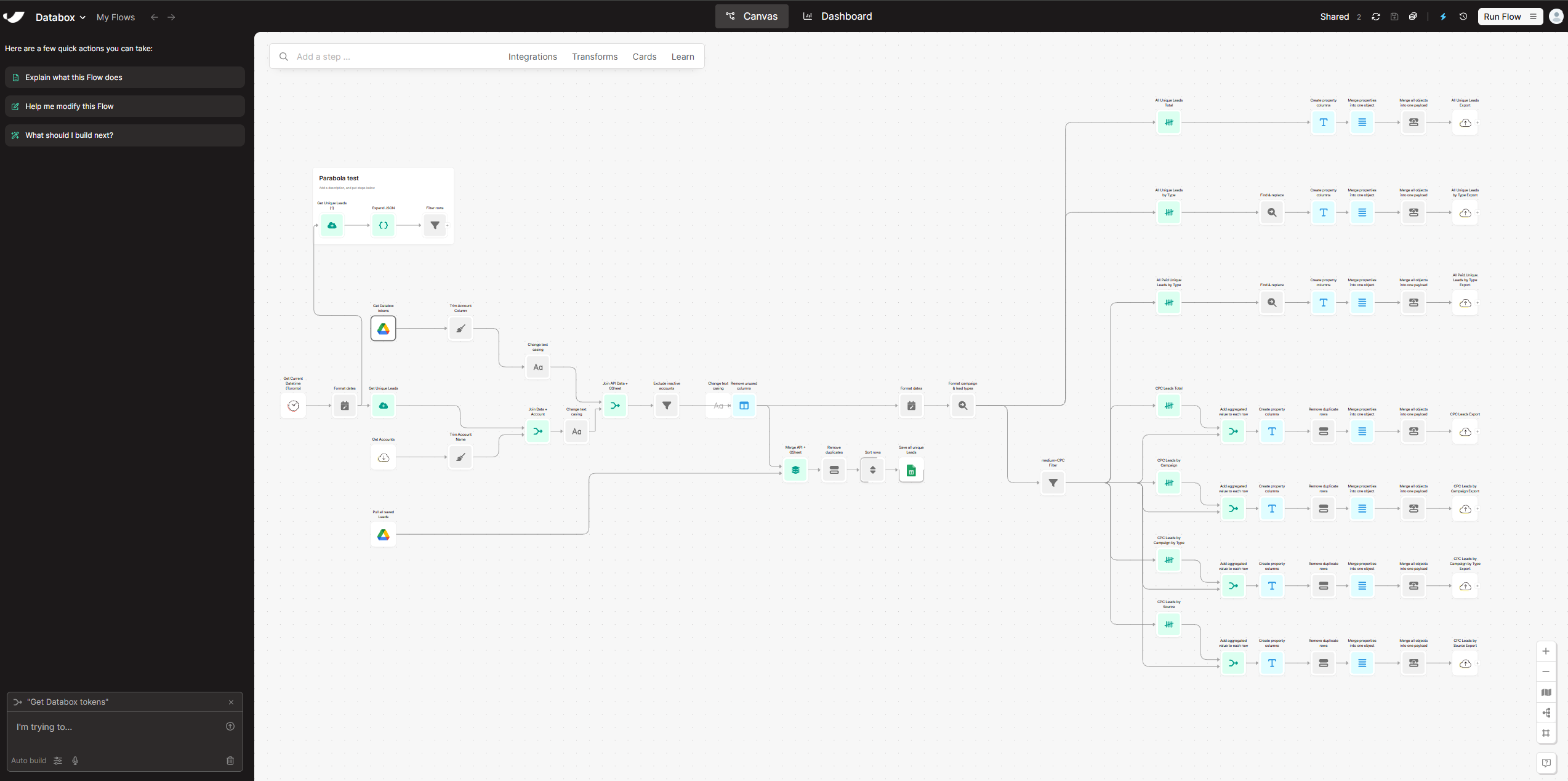
In 2022, before AI agents existed, the same problem needed solving — route the right lead to the right person, automatically, with no manual reporting. Built in Parabola. The logic is the same. The technology caught up.

35%
Reduction in cost-per-deal
100%
Inbound leads tracked & attributed
0 hrs
Manual reporting — automated away
Daily
Automated digest to dealership owners
System architecture · 417 Automotive · 2022–23
WhatConverts
Google Sheets (Master)
Parabola Pipeline
Databox Dashboard
Daily Email Digest
Flow 1 — Lead Segmentation Pipeline · Parabola · 2022
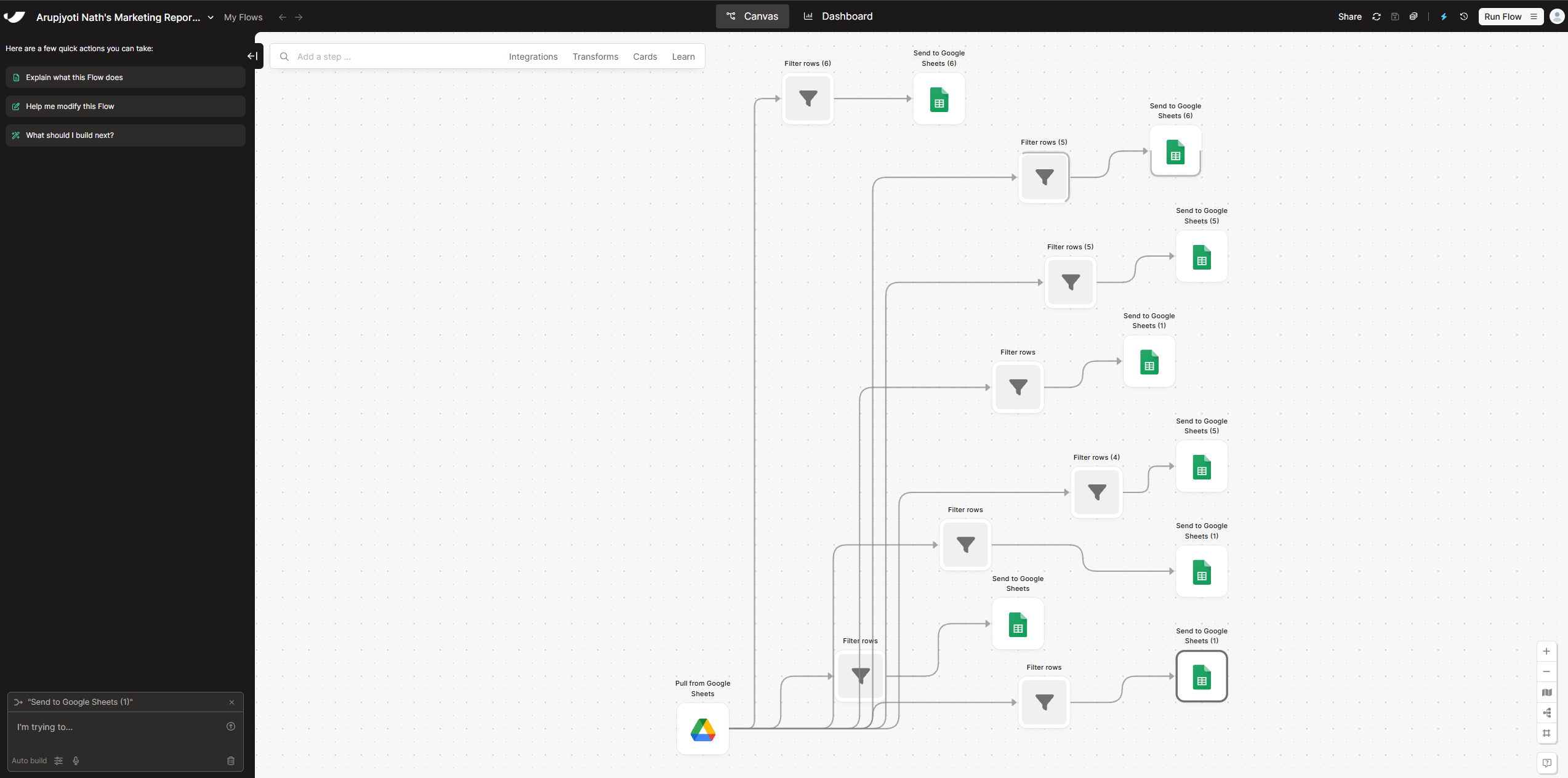
Flow 1 — Lead Segmentation Pipeline
Flow 2 — Databox KPI Pipeline · Parabola · 2022
Flow 2 — Databox KPI Pipeline

The Parabola system was deterministic — rule-based filters, fixed logic, predictable outputs. It worked well for structured data. The AI agents apply the same core instinct to unstructured work: one input, intelligent routing, the right output to the right person — but now with a confidence gate, an LLM making classification decisions, and a human-in-the-loop fallback when certainty is too low to act. Same problem. Smarter solution.

These agents do the work. They don't just tell you what to do.

The best sign that an agent is working well is that the person using it doesn't think about it.

FILTER:

21 AI marketing tools — built and running live.

Choose how you want to explore:

⚡ Inference stack SSE streaming · Prompt caching · Haiku → Sonnet routing · Human-in-loop on every output
🎯
Find by challenge
Tell me what problem your team is facing — I'll show the most relevant tool instantly
→ For HR and non-technical visitors
🔧
Browse by capability
Explore all 21 tools organised by marketing and AI discipline
→ For hiring managers and technical leads
Hiring for a specific role? Start here:
What is your team's biggest challenge right now?
★ Full agent demo
Content Pipeline Agent
4-agent pipeline — Classifier → Strategist → Writer → Editor. Every decision narrated in plain English. Try it live.
Open live demo →

↓ Click any tool to run it live — real AI output, not a demo.

I build the governance layer in before anything else.

How every workflow I build is structured
01 — Input
Trigger
Form, webhook, schedule, or API call
02 — Gate
Confidence check
<75% → human review
03 — Process
AI execution
Right model, right task
04 — Quality
Output scoring
Rubric-based evaluation
05 — Log
Audit trail
Every execution logged
06 — Deliver
Output or escalate
Pass or human queue
Confidence gates
When the AI isn't sure, it stops
Every AI step in my workflows outputs a confidence score. If it’s too low, the workflow stops and asks a human. No silent failures, no guessing.
Human-in-the-loop
Anything sensitive goes through a person first
For anything that touches real people — investors, clients, regulated content — a human approves it before it goes anywhere. That’s not a feature. It’s the point.
Audit trail
Every run is logged
Every run logs the timestamp, the model, the confidence score, and who reviewed it. If something goes wrong or someone asks what happened, you have an answer.
Kill-switch protocol
Can be turned off immediately
Any workflow I build can be turned off in under 60 seconds. Not after a deployment. Right now. That matters more than it sounds.
The principle
"I'm not the compliance officer — that's not my job and I wouldn't pretend otherwise. What I do is build the system so the compliance team only has to look at what genuinely needs their judgment. The pipes are mine. The rules about what flows through them are theirs."

Six years of marketing under compliance constraints.

Here's what that actually looks like.

35%
Cost per deal
reduction
$2M+
Annual paid
media managed
6+
Years in regulated
campaign environment
4
Data systems
connected in pipeline
WhatConverts · Google Ads
Parabola · Databox
417 Automotive Group — Financing Campaigns
417 Automotive — financing campaigns under provincial consumer protection rules
For six years I ran digital marketing for automotive financing products — car loans, bad-credit programs, in-house lending. Provincial consumer protection rules applied to every ad, every landing page, every follow-up email. Disclosure language, rate representation, approval claims — all of it had to be checked before anything went live.
What I built: A pre-approved template library for the highest-risk claim categories — cleared by sales, finance, and legal. Human review before anything went live. Six years, no compliance incidents. The thing I noticed along the way: honest messaging tends to convert better. It brings in people who actually qualify.
Consumer protection regs Disclosure language Human review gates Template library 6 years · no compliance incidents

AI Workflow Diagnostic.

Pick the thing that slows your team down most. I'll tell you what an AI workflow would look like for it — including the governance layer if you're in a regulated environment.

Your industry
Biggest manual bottleneck
Regulated environment?
Team size
AWAITING INPUT
Fill in the form and run the diagnostic
to see your personalised AI workflow recommendation.

Why I build confidence gates into every AI workflow.

The one thing that determines whether a team actually uses AI — or quietly stops.

The first workflow I built without a confidence gate failed in three weeks. The AI wasn’t producing bad output. It was producing mediocre output, consistently, and nobody could tell the difference until they checked.

People started checking everything manually. Then editing heavily. Then stopped using it. If you’re rewriting 80% of the output, it’s not automation — it’s just extra work with extra steps.

"People don't stop using AI because it's bad. They stop because they can't tell when to trust it. A confidence score fixes that."

A confidence gate is simple. Every output gets a score. Below a threshold, it goes to human review. Above it, it goes straight through. The AI flags its own uncertainty instead of hiding it.

What it does psychologically matters more than what it does technically. When people know the system will flag what it’s unsure about, they stop worrying about what might slip through. That’s what gets you from three early adopters to the whole team using it.

In a regulated environment, this becomes the compliance architecture. Anything that might contain a misleading claim or an imprecise disclosure routes to the reviewer automatically. The AI isn’t bypassing compliance — it’s making compliance faster by only surfacing what actually needs a human to look at it.

The teams that actually get AI to stick all did the same thing: they built the governance layer first. The confidence gate, the audit trail, the kill-switch — not constraints. The conditions that make it safe to let the system do more.

About this piece
From building AI workflows inside marketing teams over the past few years — some regulated, some not. Same pattern every time.
The principle in one line
Governance first. Capability second.
What I've seen happen
The whole team starts using it, not just the two people who were already comfortable with AI. Compliance signs off. Leadership stops asking to review every output. And because everything is logged, you can actually see where the system is failing and fix it.
Currently building
Competitor Intelligence Monitor — n8n + Claude + web search → weekly structured briefing digest, delivered automatically every Friday.

Certifications & continuous learning.

Completed in 2025 and 2026.

🔗
Introduction to Model Context Protocol
Anthropic Claude
The protocol behind MCP-compatible architecture — how AI agents communicate with external tools and data sources in a standardised way.
LLM Claude API AI Architecture
Issued May 2026
🤖
Fundamentals of Agents
Hugging Face
Agentic AI systems, multi-step LLM reasoning, tool use, and autonomous decision-making architectures in production environments.
Agentic AI Python LLMs
Issued May 2026
AI Fluency: Framework & Foundations
Anthropic Claude
Structured frameworks for applying Claude and LLMs effectively — prompt design, model behaviour, and responsible AI implementation patterns.
Anthropic Claude Claude API AI (Artificial Intelligence)
Issued May 2026
🪟
Create Agents in Microsoft Copilot Studio
Microsoft
Building, configuring, and deploying AI agents inside Microsoft Copilot Studio — including Microsoft Power Platform and AI Agent Development workflows.
Copilot Studio Power Platform Agent Development
Issued Jun 2026
⚙️
Automation to AI Agents: Foundation
Make
From workflow automation to agentic AI systems — connecting LLMs with triggers, actions, and decision logic inside complex multi-step marketing operations.
LLMs AI Agents Marketing Automation
Issued 2026
🟠
AI for Marketers
HubSpot
Applying AI tools and automation to marketing workflows, campaign execution, content operations, and performance measurement inside HubSpot ecosystems.
HubSpot AI Marketing Automation
Issued 2026
📊
Google Analytics Certification
Google
GA4 implementation, event tracking, attribution modelling, audience analysis, and conversion reporting — credential ID: 182821060.
GA4 Analytics Attribution
Issued May 2026 · Expires May 2027
🔍
Google Ads Search Certification
Google
Search campaign structure, keyword strategy, bidding, Quality Score, and conversion optimisation — credential ID: 182396765.
Google Ads SEM PPC
Issued May 2026 · Expires May 2027
🎯
AI-Powered Performance Ads Certification
Google
AI-driven campaign optimisation, smart bidding, Performance Max, and automated asset generation — credential ID: 182823356.
AI Ads Performance Max Smart Bidding
Issued May 2026 · Expires May 2027
⟳ In Progress DeepLearning.AI — Agentic AI Systems · AWS AIF-C01 — AI Practitioner · n8n Academy — Level 1 & 2
Arupjyoti Nath
Arupjyoti Nath
AI-Driven Marketing Leader
Burlington, Ontario
Open to remote & hybrid

The career followed the instinct, not the other way around.

I started in electrical engineering, which meant I spent years learning how to think about why things break before I ever thought about how to sell anything. It turned out that instinct — trace the problem to its source, don't patch the symptom — was more transferable than I expected.

After a Master's in Electronics Business Technology at the University of Ottawa and some early roles in analytics and campaign work, I spent a decade in marketing where the results were actually my responsibility. Paid media at 417 Automotive — where the cost per deal dropped 35%. Analytics and reporting at Schneider Electric. Demand generation at an early-stage SaaS startup where paid traffic grew 62% and sales leads followed at 57%. None of it was advisory work.

At Zymbyo, I was CMO and CPO at the same time — which meant owning the marketing function, the product roadmap, a team of five, and 15+ client accounts simultaneously. I built a product-led growth motion that acquired 29 clients across the US and Canada through product value alone — no outbound sales — and 7 of them converted to paid within six months. That's a 24% free-to-paid rate against a 2–5% industry average. I also built Zymbyo's AI platform from scratch — from the first integration to a production system with 21 live tools, 6 agent architectures, and 1 fully deployed production agent.

The team-building side mattered as much as the results. At Zymbyo, that meant recruiting into a startup with no inherited playbook — setting direction, maintaining accountability, and keeping a lean team productive under real pressure. At 417 Automotive and Schneider Electric, it meant working across functions and reporting to senior leadership where the work either spoke for itself or it didn't.

If you're building a marketing function that needs to outperform — let's talk.

I'm looking for a role where commercial accountability, AI implementation, and team-building sit in the same seat — and where the work is measured by what it produces, not what it resembles. Burlington, Ontario. Open to remote and hybrid.

🤖
Arup's AI Consultant
Agentic RAG — powered by Claude